
Precision Plastic Helical Gears
pt_001
Specifications
- Product Category: Precision Transmission Components
- Module Range: M0.2 to M1.5 (Micro to standard module tooling)
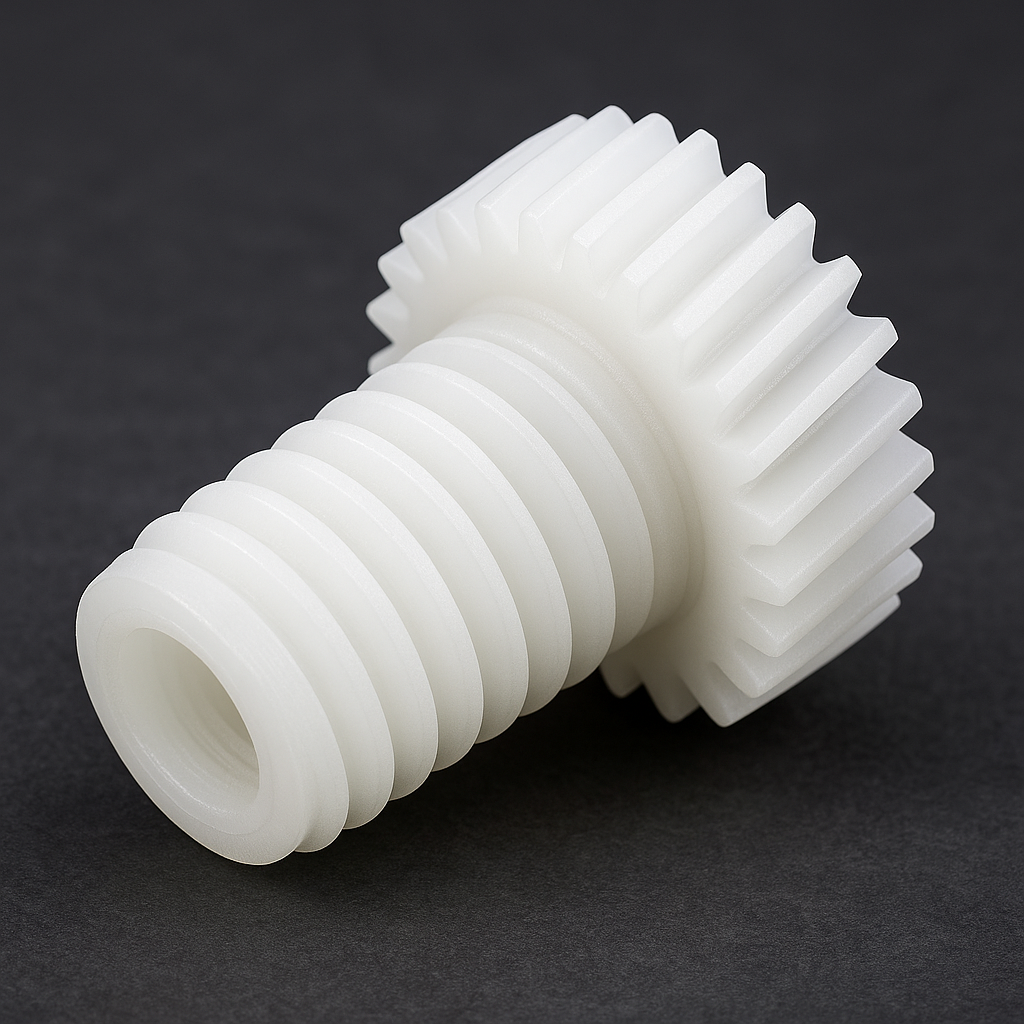
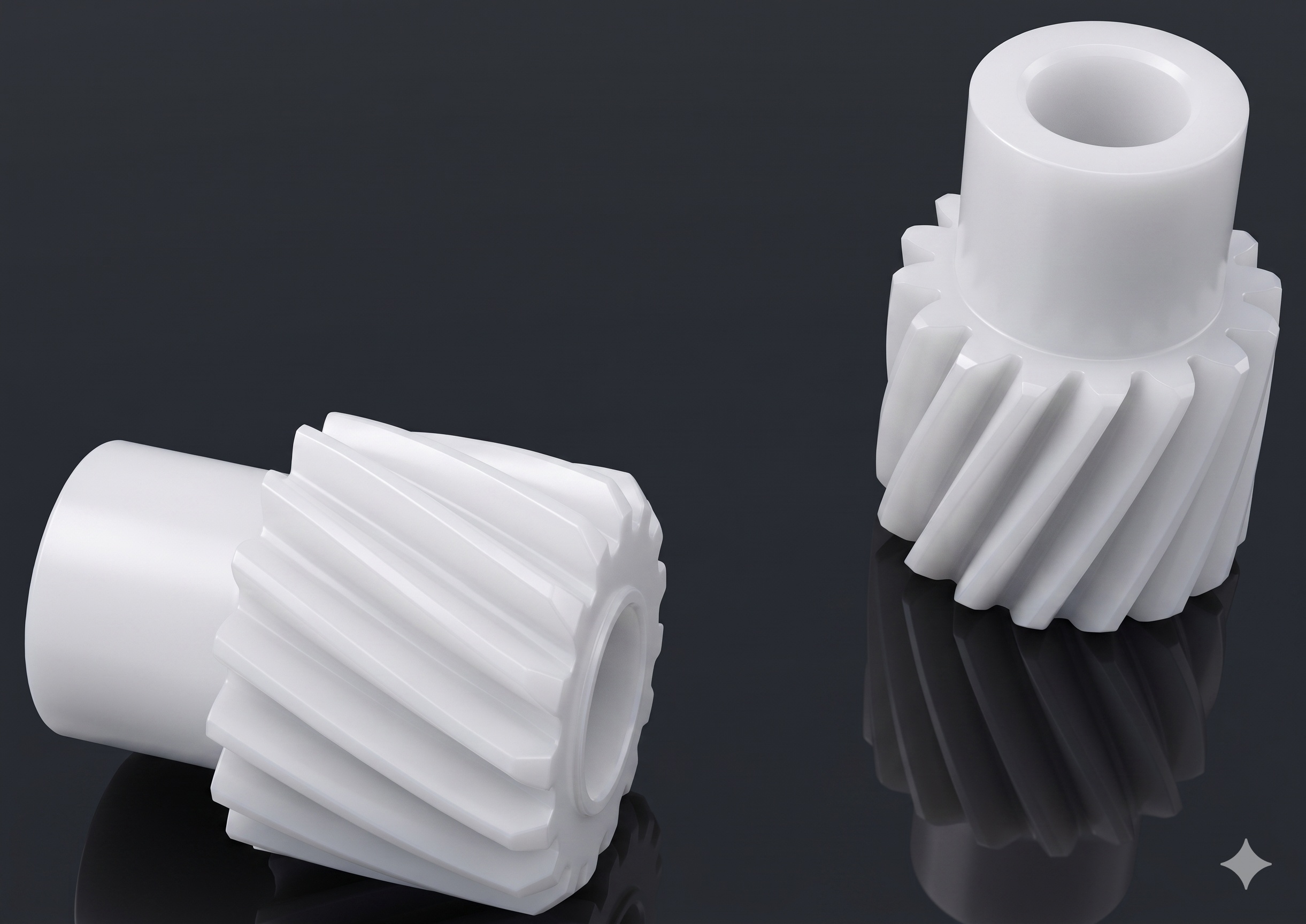
- Drive Types: Helical Gear Mesh / Worm & Helical Gear Drives
- Standard Materials: Wear-resistant POM (Polyoxymethylene / Acetal), Engineering Nylon (PA66 / PA46 / Glass-filled PA)
- Primary Functions: High-ratio worm drive pairing, torque amplification, noise suppression, 90° crossed-axis directional transmission
- Custom Inquiries: Custom molding available; please provide drawings or parameters (Module, Tooth Count, Helix Angle, Hand of Helix, Face Width, Bore Diameter)
- Applications: Medical Actuators, Smart Home Appliances, Automotive Actuators, Power Tool Gearboxes, Precision Automation Drivetrains
Manufacturing Processes & Capabilities
- Micron-Precision Tooling & Helical Profile Optimization: Covers M0.2 to M1.5 modules with micro-tolerance tooling; precisely controls helix angle, tooth profile, and pitch-circle runout with mold shrinkage compensation for burr-free, uniform teeth.
- Low-Stress Injection & Concentricity Control: Molded from premium POM and PA resins with optimized packing profiles to eliminate internal stress and warpage, ensuring concentricity between the bore and pitch circle for jitter-free rotation.
Features & Advantages
- High Contact Ratio, High Torque & Low Noise: Gradual tooth engagement provides a higher contact ratio than spur gears, distributing loads across multiple teeth to increase torque capacity while eliminating high-frequency meshing whine.
- Crossed-Axis Compatibility & High-Ratio Reduction: Ideal for pairing with worms in 90° crossed-axis layouts, delivering high-reduction ratios, torque amplification, and mechanical self-locking within compact envelopes.
- Self-Lubricating, Wear-Resistant & Maintenance-Free: Engineered POM and Nylon resins offer superior wear resistance, low friction, and continuous self-lubrication, ensuring long-term durability in unlubricated or low-maintenance environments.
About Plastic Gears
A gear is a toothed wheel designed to transmit force to another gear or toothed component. The teeth of a gear can be shaped to minimize wear, vibration and noise, and to maximize the efficiency of power transmission.
Gears of differing size are often used in pairs for a mechanical advantage, allowing the torque of the driving gear to produce a larger torque in the driven gear at lower speed, or a smaller torque at higher speed.
- Plastic gears are easily molded into various shapes so they have wider range of configuration.
- Plastic gears are less expensive and are lighter in weight.
- Plastic gears are chemical and corrosion resistant.
- Plastic gears have quieter and smoother operation and offer more efficient drive geometry.
- Plastic gears are with inherent self lubricating.
While plastic gears offer these many advantages over metal gears, their effective use requires proper design and engineering to account for possible dimensional and property variations over the expected range of operating conditions.